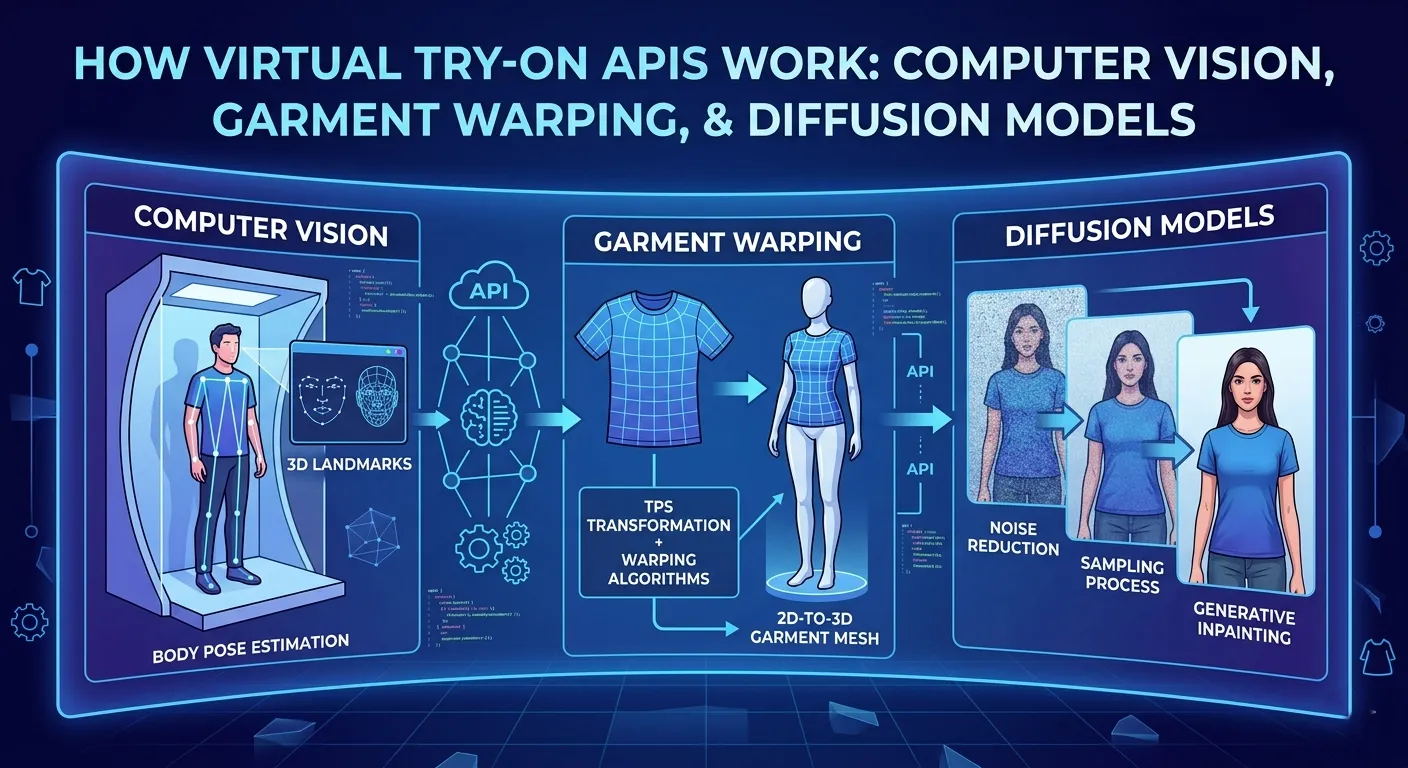


Open-source virtual try-on models have gotten genuinely impressive. IDM-VTON, OOTDiffusion, CatVTON, you can find them on GitHub, download the weights, and run a demo that looks publication-ready in an afternoon. It’s tempting to assume that means you can build a production virtual try-on system for free.
You can’t. But the real cost isn’t always obvious until you’re three weeks into a setup that still isn’t stable.
This guide breaks down what open-source VTON actually requires to run in production, GPU specs, real infrastructure costs, and engineering overhead and when a managed API like Fitroom is the more practical choice. We’ll use real numbers, not estimates.
GPU pricing data sourced from RunPod, Lambda Labs, and AWS (2025–2026). IDM-VTON hardware requirements sourced from the official GitHub repository and community issue tracker.
What Open-Source VTON Actually Is
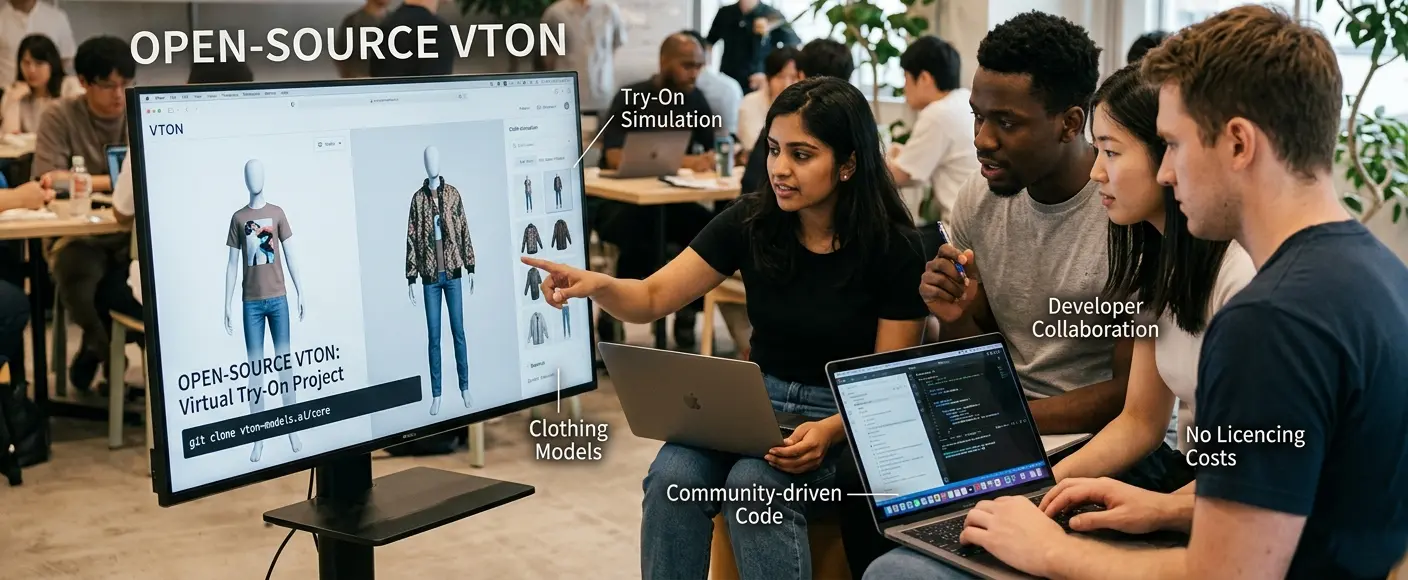
When developers talk about “open-source VTON,” they’re usually referring to research models published as public repositories with pretrained weights. The most widely used ones right now:
IDM-VTON (ECCV 2024): currently the most popular, with 4.8K GitHub stars. Uses a dual-encoder diffusion architecture. Strong on garment detail preservation, particularly for complex textures and prints.
OOTDiffusion: outfitting with diffusion, designed for both upper-body and full-body try-on. Lighter VRAM footprint than IDM-VTON in some configurations.
CatVTON: more recent, designed for efficient inference with lower resource requirements than earlier diffusion-based models.
StableVITON: flow-based warping combined with a diffusion backbone. Good at preserving garment geometry.
All of these are released as research repositories: model checkpoints, inference scripts, and demo implementations. They are not production systems. The distinction matters more than it might seem.
A research repository is optimized to demonstrate model quality on controlled inputs. A production system needs to handle everything else: malformed uploads, unusual poses, concurrent requests, failures, retries, and consistent latency under load. Most open-source VTON repositories ship none of that infrastructure. You build it yourself.
What Open-Source VTON Actually Needs
This is where most “it’s free” calculations fall apart. IDM-VTON, the leading open-source model has hard GPU requirements that are easy to underestimate.
From the official GitHub repository and community issue tracker, the real-world numbers are:
| GPU | VRAM | Inference time per image | Status |
|---|---|---|---|
| RTX 4090 | 24GB | ~8 seconds | ✅ Works well |
| RTX 4080 Super | 16GB | ~5 minutes | ⚠️ VRAM overflows to system RAM |
| NVIDIA T4 | 16GB | — | ❌ Out of memory error |
| A100 80GB | 80GB | ~5–10 seconds | ✅ Works well, overkill for inference |
The minimum viable GPU for IDM-VTON in production is a 24GB VRAM card. The T4, one of the most common cloud inference GPUs fails entirely. The 16GB RTX 4080 Super technically runs, but at 5 minutes per image it’s unusable for any real product workflow.
This has a direct implication for cloud costs. You can’t use the cheapest GPU tier. You need 24GB+ VRAM, which means RTX 4090, A100, or equivalent.
What Self-Hosting Actually Costs
Cloud GPU pricing for 24GB+ VRAM cards in 2025–2026:
| GPU | Provider | Cost/hour | Cost/month (24/7) | Cost/month (8h/day) |
|---|---|---|---|---|
| RTX 4090 (24GB) | RunPod Community | ~$0.34/hr | ~$245 | ~$82 |
| RTX 4090 (24GB) | Vast.ai spot | ~$0.29/hr | ~$209 | ~$70 |
| A100 40GB | Lambda Labs | ~$1.29/hr | ~$930 | ~$310 |
| A100 80GB | RunPod Secure | ~$1.99/hr | ~$1,433 | ~$478 |
| A100 80GB | AWS on-demand | ~$4.10/hr | ~$2,952 | ~$984 |
Realistically, a team running open-source VTON for a production e-commerce workflow needs the GPU available when users are active. 8 hours/day, 5 days/week on a RunPod RTX 4090 runs approximately $200–$250/month in pure compute. That’s before storage, networking, monitoring, or the GPU instance being up while you’re debugging.
A 24/7 always-on setup for consistent availability runs $210–$930/month depending on GPU tier and provider — again, just for compute.
The costs that don’t show up in the GPU bill
GPU hosting is the visible cost. The hidden costs are usually larger:
Setup time. Getting IDM-VTON running involves: Python environment setup, CUDA compatibility resolution, dependency version conflicts (the repository requires specific versions of diffusers, transformers, and accelerate that may conflict with your existing stack), downloading multiple model checkpoints across different components (DensePose, human parsing models, OpenPose, the main VTON checkpoint), and writing the inference wrapper that actually fits your use case. For a developer who hasn’t done this before, budget 1–2 weeks. For a team that has, budget 3–5 days.
Production infrastructure. Running inference in a demo is different from running it in production. You need a queue system (so concurrent requests don’t crash the GPU), async task handling (so users get a task ID and poll for results rather than blocking), input validation (bad images don’t waste GPU time), error handling and retry logic, and result storage (where do output images live, and for how long). None of this comes with the repository.
Ongoing maintenance. Models update. Dependencies update. CUDA versions update. Someone on your team owns this indefinitely. If your one ML engineer leaves, the system becomes a liability.
Factoring in engineering time at even a conservative rate, the real first-year cost of a self-hosted VTON system for a small team is typically $15,000–$40,000 — including setup, infrastructure, and the portion of an engineer’s time spent maintaining it.
What a Managed API Actually Gives You

A managed virtual try-on API abstracts away the infrastructure layer entirely. You send two images, you get one back. The GPU, the queue, the retry logic, the model updates, none of that is your problem.
Fitroom’s API is built specifically for fashion e-commerce and production workflows. A few things worth understanding about how it’s designed, covered in more detail in How Fitroom Virtual Try-On API Works:
Input validation before you process anything. Two dedicated endpoints — Check Model Image and Check Clothes Image — validate inputs before the try-on runs. You get specific error codes (pose not forward, multiple people in frame, garment type mismatch) before a credit is consumed. Most open-source setups require you to build this validation layer yourself, or absorb the cost of failed generations.
Combo try-on in one request. Upper + lower garments processed simultaneously in a single API call. Self-hosting IDM-VTON for outfit try-on means two inference passes — double the compute time and GPU cost per outfit.
Async task model with progress tracking. Standard mode completes in ~9 seconds. HD mode in ~30 seconds. The task status endpoint returns a 0–100 progress value, not just binary pending/done — useful for building real progress UI.
Clothes classifier as a standalone feature. Auto-tags garments by category, occasion, and style at 0.5 credits per call. Useful for catalog automation without building a separate classification pipeline.
Cost comparison: managed API vs self-hosted
| Monthly volume | Fitroom (subscription) | Self-hosted RTX 4090 (8h/day) | Self-hosted RTX 4090 (24/7) |
|---|---|---|---|
| 200 images | $12 | ~$82 (GPU alone) | ~$245 (GPU alone) |
| 1,000 images | $35 | ~$82–$245 (GPU alone) | ~$245+ (GPU alone) |
| 5,000 images | $120 | ~$200–$300 (GPU + storage) | ~$300–$500 (GPU + storage) |
| 20,000 images | $400 | ~$400–$700 (multi-GPU needed) | ~$700–$1,200 (multi-GPU) |
| 50,000 images | $800 | ~$800–$1,500+ (scaling) | ~$1,500–$3,000+ |
At low volumes, managed APIs are dramatically cheaper, you’re not paying for GPU infrastructure that sits idle most of the time. At high volumes (50K+ images/month), the math starts to converge, but self-hosting still requires the engineering investment to build and maintain the production stack.
For a full pricing comparison of managed VTON APIs against each other, see our virtual try-on API comparison. For a detailed technical breakdown of FASHN.ai as an alternative, see our FASHN.ai alternatives guide.
Build vs Buy: The Honest Decision Framework
The “build vs buy” question in VTON is usually less about model quality and more about what your team is actually optimized to do.
Self-hosting open-source VTON makes sense when:
- Customization is a core product advantage. If your product requires fine-tuned models, proprietary training data, or pipeline modifications that no managed API can replicate — build. Fashion brands with unique aesthetic requirements or specific body-type optimization needs sometimes fall here.
- You have strong ML infrastructure already. If your team maintains GPU clusters, has ML engineers comfortable with diffusion model deployment, and already runs similar inference pipelines — the marginal cost of adding VTON is lower than for a team starting from scratch.
- Data residency requirements prevent external APIs. Some enterprise fashion brands have legal or contractual requirements that prevent user photos from leaving their infrastructure. Self-hosting is sometimes the only option here.
- You’re processing at very high volume. At 500K+ images/month, the per-image economics of cloud APIs can exceed the cost of owned infrastructure. This is a real threshold, but it’s much higher than most teams reach before finding product-market fit.
Managed APIs make more sense when:
- You’re still validating the product. The most expensive mistake in virtual try-on is spending 3 months building infrastructure for a feature that users don’t engage with. Managed APIs let you test the actual product value for $12–$120/month before committing engineering resources to infrastructure.
- Your team’s core skill isn’t ML infrastructure. Most fashion e-commerce teams and startups are building products, not ML systems. Every week spent on CUDA dependencies and GPU autoscaling is a week not spent on product, UX, or catalog growth.
- Speed to production matters. Managed API integration can be live in a day. A production-stable self-hosted VTON system takes 2–4 weeks minimum, and that’s assuming nothing goes wrong with the environment setup. As detailed in how Fitroom’s API is designed, the integration is a standard REST workflow: validate inputs, create task, poll for result.
- You need predictable costs. Self-hosted GPU costs vary with usage spikes, scaling events, and idle time. Managed API pricing is per-image — you pay for what you use, nothing more.
Side-by-Side Comparison
| Factor | Open-source VTON (self-hosted) | Managed VTON API (Fitroom) |
|---|---|---|
| Minimum GPU requirement | 24GB VRAM (RTX 4090 / A100) | None — handled by provider |
| Setup time | 1–4 weeks (environment, deps, infra) | ~1 day (REST integration) |
| Inference speed (IDM-VTON) | ~8s on RTX 4090 / ~5min on 16GB GPU | ~9s standard / ~30s HD |
| Infrastructure cost (low volume) | $200–$500/month (GPU alone) | $12–$35/month |
| Infrastructure cost (50K images/mo) | $800–$3,000+/month | $800/month |
| Input validation | Build yourself | ✅ Built-in endpoints |
| Async queue + task management | Build yourself | ✅ Built-in |
| Combo try-on (upper + lower) | Two inference passes required | ✅ Single request |
| Clothes classifier | Separate model required | ✅ Built-in (0.5 credits/call) |
| Model updates | Your team’s responsibility | Handled by provider |
| Scalability | Engineering problem (GPU autoscaling) | API rate limits, no infra work |
| Customization | Full — fine-tune, modify pipeline | Limited to API parameters |
| Best suited for | ML-heavy teams, high volume, custom needs | E-commerce, startups, rapid deployment |
The Honest Verdict
Open-source VTON models are genuinely impressive. IDM-VTON produces results that are competitive with commercial systems in controlled conditions. If you have a 24GB VRAM GPU, the right dependencies installed, and someone who knows their way around diffusion model deployment — you can get a working demo in an afternoon.
Getting from that demo to a production system that handles real user uploads, scales with traffic, and runs reliably for months without someone babysitting it is a fundamentally different project. Most teams underestimate how much of that work falls outside the model itself.
For teams that are still validating product-market fit, processing under 50K images/month, or don’t have dedicated ML infrastructure — the managed API calculus is straightforward. You pay more per image than you would at theoretical self-hosted scale, and in exchange you skip months of infrastructure work and ongoing maintenance ownership.
The right time to evaluate self-hosting is when you’ve already validated the product, have consistent high volume, and have the engineering resources to own the full stack. At that point, the conversation is worth having. Before that point, it’s usually a distraction.
Frequently Asked Questions
Can I run IDM-VTON for free?
The model weights are free to download, but running IDM-VTON in production requires a GPU with at least 18–24GB VRAM. On a consumer RTX 4090 (24GB), inference takes approximately 8 seconds per image. On a 16GB GPU, it takes around 5 minutes — unusable for production. Cloud GPU hosting for a viable setup costs $200–$700/month in compute alone, before engineering and maintenance.
What GPU does IDM-VTON require?
IDM-VTON requires a minimum of 18GB VRAM for single image inference. An RTX 4090 (24GB) processes one image in approximately 8 seconds. An RTX 4080 Super (16GB) overflows to system RAM and takes ~5 minutes per image. A T4 (16GB) fails with an out-of-memory error.
When does self-hosting VTON make sense?
Self-hosting makes sense when you have specific customization requirements, strong ML infrastructure already in-house, data residency requirements that prevent external APIs, or volume high enough (typically 500K+ images/month) that per-image API costs exceed infrastructure costs. For most teams, managed APIs are faster and cheaper until they reach that scale.
How does Fitroom compare to self-hosting IDM-VTON?
Fitroom starts at $12/month for 200 images and processes each in under 10 seconds with no GPU setup. Self-hosting IDM-VTON at comparable throughput requires a 24GB VRAM GPU, costs $200–$700/month in cloud compute, and requires 2–4 weeks of engineering setup plus ongoing maintenance. At volumes above 50K images/month, the costs start to converge — but self-hosting still requires the full engineering investment to build the production stack.